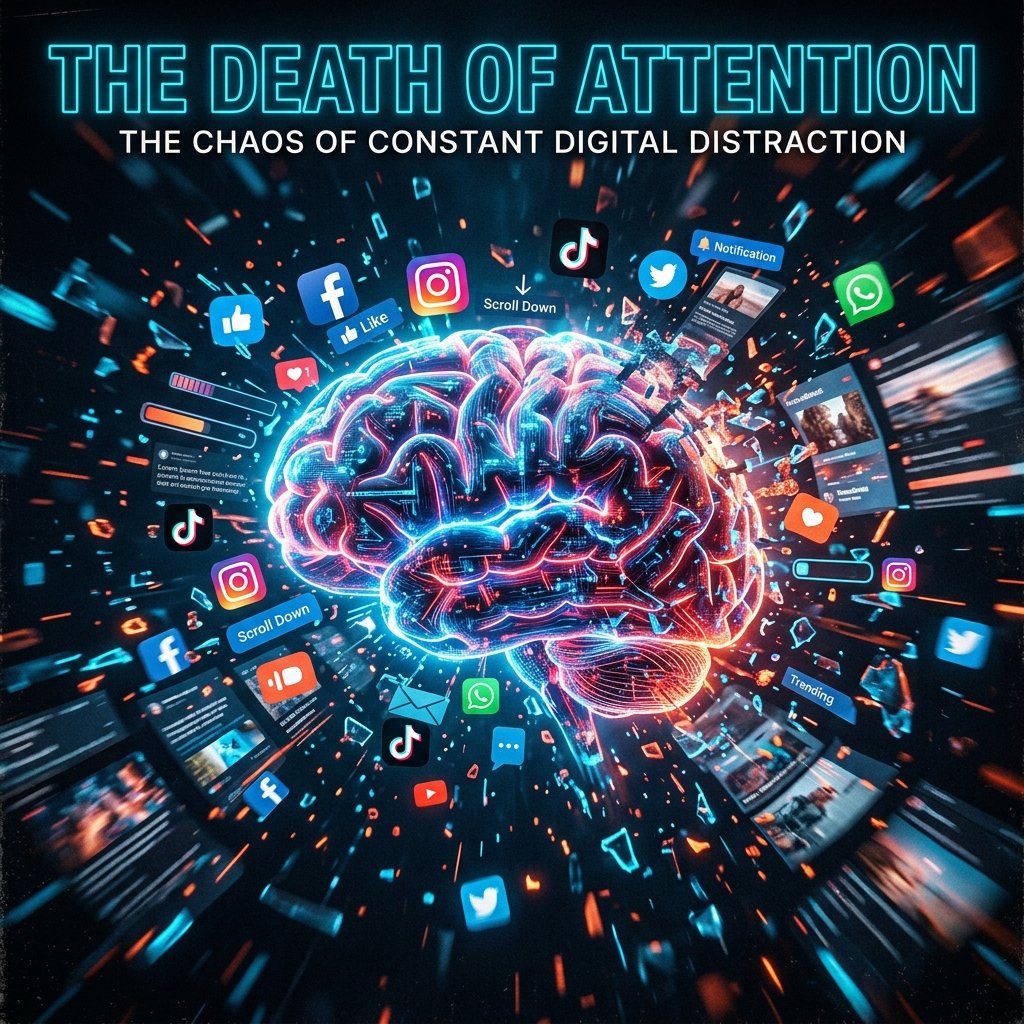
Introduction: The Most Valuable Resource on Earth
Gold has value.
Oil has value.
Land has value.
But there is another resource that may be even more valuable than all of them combined.
Human attention.
Every meaningful achievement in human history has required it.
Building a business requires attention.
Raising a family requires attention.
Learning a skill requires attention.
Creating art requires attention.
Solving problems requires attention.
Love requires attention.
Civilizations are built upon the ability of human beings to focus their minds on meaningful goals over extended periods of time.
Attention is the foundation of everything.
And today, it is under attack.
For most of human history, attention was directed primarily toward survival, family, community, and purpose. Distractions certainly existed, but they were limited by geography, technology, and circumstance.
Then came smartphones.
Then came social media.
Then came algorithms designed to compete relentlessly for every spare moment of human awareness.
The result is one of the largest behavioral experiments ever conducted.
Billions of participants.
No informed consent.
No long-term control group.
No clear understanding of the consequences.
The question is no longer whether social media affects attention.
The question is how much.
The Attention Economy
The modern internet is not free.
It only appears free.
Every major social media platform depends upon a business model built around advertising revenue.
Advertising revenue depends upon engagement.
Engagement depends upon time.
Time depends upon attention.
The longer users remain on a platform, the more advertisements can be displayed.
The more advertisements displayed, the more money is generated.
As a result, the world’s largest technology companies are not simply competing against one another.
They are competing against books.
Against exercise.
Against hobbies.
Against family dinners.
Against sleep.
Against face-to-face conversation.
Against every other activity that occupies human time.
The objective is simple:
Capture attention.
Retain attention.
Monetize attention.
Human attention has become one of the most valuable commodities on earth.
And social media companies have become extraordinarily effective at harvesting it.
The End of Boredom
For most of human history, boredom was unavoidable.
People stood in line.
They waited for appointments.
They sat quietly.
They walked without entertainment.
They daydreamed.
They reflected.
These moments were not wasted.
Many of humanity’s greatest ideas emerged during periods of boredom and reflection.
The brain requires downtime.
Creativity often emerges from silence.
Insight often emerges from stillness.
Social media has largely eliminated those moments.
Waiting in line becomes scrolling.
Sitting at a restaurant becomes scrolling.
Standing in an elevator becomes scrolling.
Lying in bed becomes scrolling.
Every idle moment becomes another opportunity for consumption.
Many people now experience discomfort when separated from their phones for even brief periods.
Silence feels strange.
Boredom feels intolerable.
The mind has become accustomed to constant stimulation.
Yet constant stimulation comes at a cost.
When the brain is never allowed to rest, it may lose some of its capacity for reflection, imagination, and deep thought.
The Fragmentation of Attention
Attention functions much like a spotlight.
It illuminates what matters while filtering out distractions.
The problem is that social media continuously moves the spotlight.
A notification appears.
The spotlight moves.
A message arrives.
The spotlight moves.
A video starts playing.
The spotlight moves.
A headline appears.
The spotlight moves again.
Over time, attention becomes fragmented.
Instead of sustained concentration, the brain becomes conditioned for rapid switching.
This process is sometimes referred to as attentional fragmentation.
The consequences are significant.
Research has consistently shown that interruptions reduce productivity and increase cognitive load.
Every interruption requires the brain to reorient itself.
That reorientation consumes mental energy.
When interruptions occur dozens or hundreds of times per day, the cumulative effect can be substantial.
Many people report difficulty reading books.
Difficulty focusing on work.
Difficulty completing projects.
Difficulty remaining fully present during conversations.
The issue is not intelligence.
The issue is attention.
And attention is increasingly under siege.
Why Reading Is Becoming More Difficult
Books demand something social media rarely requires.
Patience.
A book asks the reader to remain engaged with a single idea for an extended period of time.
It requires focus.
Concentration.
Persistence.
Social media rewards the opposite.
Swipe.
Scroll.
Click.
Refresh.
Move on.
The average piece of content is consumed in seconds.
Attention becomes trained for novelty rather than depth.
For stimulation rather than understanding.
For reaction rather than reflection.
Many educators have reported that students increasingly struggle with sustained reading.
Adults report similar experiences.
People who once read several books per month now find themselves struggling to finish a single chapter.
The issue is not literacy.
The issue is conditioning.
The brain adapts to the environment in which it operates.
When attention becomes accustomed to constant novelty, slower forms of learning become more difficult.
Not impossible.
But more difficult.
The TikTok Effect
No platform better represents the modern attention economy than TikTok.
Its genius lies in its simplicity.
Open the application.
Instant entertainment.
No searching.
No effort.
No delay.
The algorithm immediately begins delivering personalized content.
Every swipe produces something new.
The result is an almost frictionless experience.
Hours can disappear without conscious awareness.
TikTok did not invent short-form content.
But it perfected it.
And in doing so, it influenced nearly every other major platform.
Instagram introduced Reels.
YouTube introduced Shorts.
Facebook emphasized short-form video.
The entire industry moved in the same direction.
Shorter.
Faster.
More stimulating.
More addictive.
The concern is not merely entertainment.
The concern is adaptation.
What happens when an entire generation grows up consuming information in fifteen-second increments?
What happens when the brain becomes conditioned to expect constant novelty?
The long-term answer remains uncertain.
But the question deserves serious consideration.
Children Growing Up in the Attention Economy
No generation in history has experienced childhood under these conditions.
Today’s children are born into a world of constant digital stimulation.
Many receive smartphones before adolescence.
Some receive them before middle school.
By the time they reach high school, many have spent thousands of hours interacting with algorithms specifically designed to maximize engagement.
These algorithms do not ask whether content is beneficial.
They ask whether content is engaging.
The distinction matters.
Children are still developing.
Their brains are still adapting.
Their habits are still forming.
The environments they experience help shape who they become.
Previous generations spent more time outdoors.
More time reading.
More time engaging in face-to-face play.
More time experiencing unstructured boredom.
Today’s children increasingly spend those hours online.
The consequences remain uncertain.
But uncertainty should not be confused with safety.
The Cost to Relationships
Attention is the foundation of relationships.
People feel loved when they are listened to.
Children feel valued when they receive focused attention.
Friendships deepen through presence.
Marriages strengthen through connection.
Social media often competes directly with these experiences.
A family sits together while everyone stares at a screen.
A couple spends an evening scrolling instead of talking.
Parents become distracted by notifications while interacting with their children.
These moments may seem insignificant individually.
Collectively, they shape relationships.
Human beings crave attention because attention communicates value.
When devices continuously interrupt relationships, relationships inevitably suffer.
A Society That Cannot Focus
The implications extend beyond individuals.
Attention is not merely a personal resource.
It is a societal resource.
Democracies require informed citizens.
Businesses require focused employees.
Schools require attentive students.
Communities require engaged participants.
Scientific breakthroughs require deep concentration.
Innovation requires sustained effort.
What happens when an entire society struggles to focus?
What happens when constant distraction becomes normal?
What happens when depth is replaced by speed?
The answers are still unfolding.
But they may influence the future of culture, education, business, politics, and human flourishing.
Reclaiming Attention
The goal is not to reject technology.
Technology has improved countless aspects of modern life.
The challenge is using technology intentionally.
Rather than allowing it to use us.
Reclaiming attention begins with awareness.
Awareness of how platforms operate.
Awareness of how attention is monetized.
Awareness of how habits are formed.
Practical actions can help:
- Turn off unnecessary notifications.
- Read books regularly.
- Schedule phone-free periods.
- Create before consuming.
- Spend more time outdoors.
- Prioritize face-to-face relationships.
- Take periodic social media breaks.
None of these actions require abandoning modern life.
They simply require becoming more intentional about how attention is spent.
Conclusion: Attention Is Life
Every meaningful thing in life requires attention.
Love requires attention.
Learning requires attention.
Growth requires attention.
Purpose requires attention.
Attention is life.
Where attention goes, life follows.
The social media age has created extraordinary opportunities for communication and connection.
But it has also created powerful incentives to capture and monetize human attention.
The result is a society that often feels distracted, overwhelmed, fragmented, and exhausted.
The death of attention is not inevitable.
But preserving attention will require conscious effort.
Because if attention is the foundation of a meaningful life, then protecting it may become one of the most important responsibilities of the twenty-first century.
The battle for attention is already underway.
The only question is whether enough people recognize it before even more of it disappears.
References
- American Psychological Association. Health Advisory on Social Media Use in Adolescence.
- Nicholas Carr. The Shallows: What the Internet Is Doing to Our Brains.
- Pew Research Center. Americans’ Social Media Use.
- Pew Research Center. Teens, Social Media and Technology.
- U.S. Surgeon General Advisory on Social Media and Youth Mental Health.
- Jonathan Haidt. The Anxious Generation.
- Selected peer-reviewed research on attention, multitasking, digital media use, and cognitive performance.